If you have ever tried to use an aged shelf company to qualify for business funding, you already know the frustration. You transfer the company, submit the application, and then nothing. Declined. No explanation. Just silence.
Here is the truth most shelf company sellers will never tell you: the reason you got denied likely had nothing to do with your personal credit. The problem was the company itself. More specifically, it was a dirty shelf corporation masquerading as a clean one, and lenders spotted it within minutes.
In this guide, we break down exactly what separates a clean-aged shelf company from a problematic one, what lenders actually check during the review process, and how to protect yourself before spending a single dollar on an aged entity.
What Is a Clean Aged Shelf Company?
A clean-aged shelf company is a legally formed business entity that has been held dormant since the day of its incorporation. No bank accounts. No loans. No tax filings with any financial activity. No contracts signed. No payroll. No nothing.
The only asset it carries is time, a legitimate formation date that gives you instant time-in-business credibility the moment ownership is transferred to you. For lenders who require one to two years of business history before approving funding, this single detail can be the difference between an approval and an automatic denial.
| Key Insight: A clean shelf company does not fabricate history. It transfers real, verifiable history — the kind that holds up under lender scrutiny. |
Why “Age” Matters So Much in Business Lending
According to the U.S. Small Business Administration (SBA), business age is one of the primary factors lenders use to assess risk. A company that has been operating for two or more years is statistically far less likely to default than a startup. This is why lenders, from traditional banks to alternative funding platforms, set hard minimums on time in business.
When you transfer a genuinely clean aged shelf company, you inherit that age legally and legitimately. The Secretary of State records show the original formation date. The EIN history is traceable. The documentation is real. That is what makes it powerful.
What Makes a Shelf Company “Dirty”? The Hidden Risks Most Buyers Miss
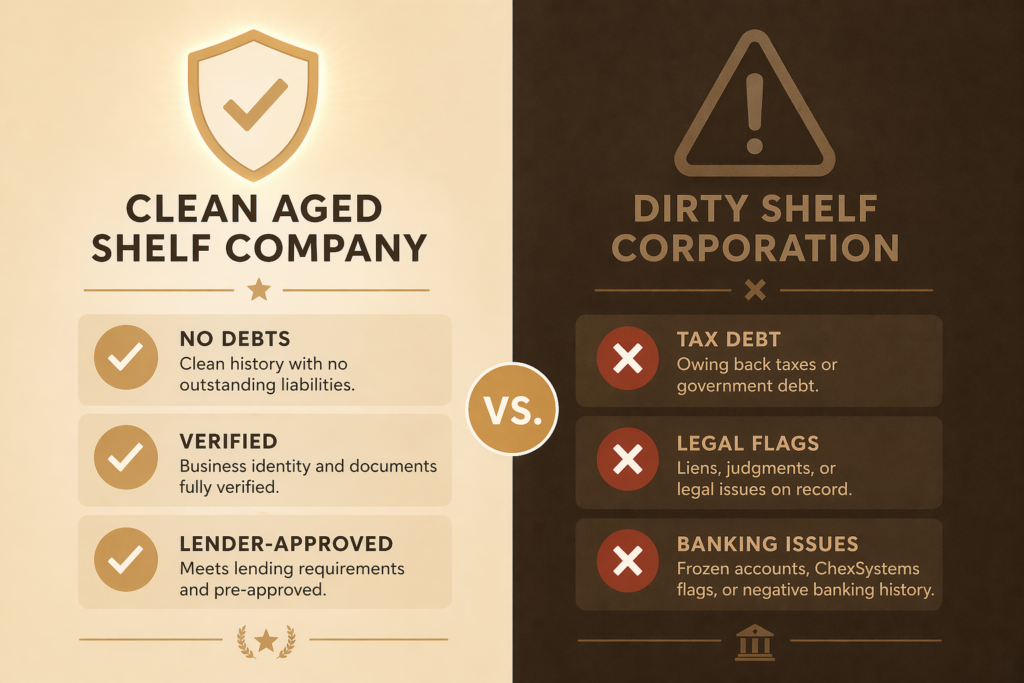
A dirty shelf corporation is not always easy to spot at first glance. It may have been formed years ago, just like a clean one. It may come with a registered agent and state good-standing status. But underneath the surface, it carries problems that can instantly destroy your funding application, or worse, trigger a fraud investigation.
Common Signs of a Dirty Shelf Corporation
- Prior tax debt or unfiled IRS returns: If the EIN was ever used and taxes were not filed, the IRS attaches that liability to the company, and to you, the moment you take ownership.
- Suspicious banking history: Accounts that were opened and closed under adverse circumstances, overdrafts, or chargeback histories appear in databases like ChexSystems and EWS. Lenders pull these records.
- Liens and judgments: Any legal action filed against the company, including unpaid vendor invoices or civil judgments, is publicly searchable and will surface during a lender’s due diligence review.
- Commercial database flags: LexisNexis Risk Solutions and Dun & Bradstreet maintain extensive records on business entities. Even minor activity can leave a data trail that raises red flags.
- Dissolved and reinstated companies: A company that was once dissolved and later reinstated has a broken compliance history. Lenders can trace this through Secretary of State records and will view it as a warning sign.
- Prior owners with damaged reputations: If the original officers or registered owners have fraud histories, derogatory public records, or debarment from federal programs, that history follows the company even after transfer.
| Real Example: A business owner in Texas purchased a $2,000 shelf company from an online marketplace. It had a five-year-old formation date. Within 48 hours of applying for a business line of credit, the application was denied. The reason? The company’s EIN had two years of unfiled 1099s attached to it from a prior owner who had used it for freelance income. The lender flagged it immediately. The owner had no idea. |
What Lenders Actually Check: A Step-by-Step Look at Their Review Process
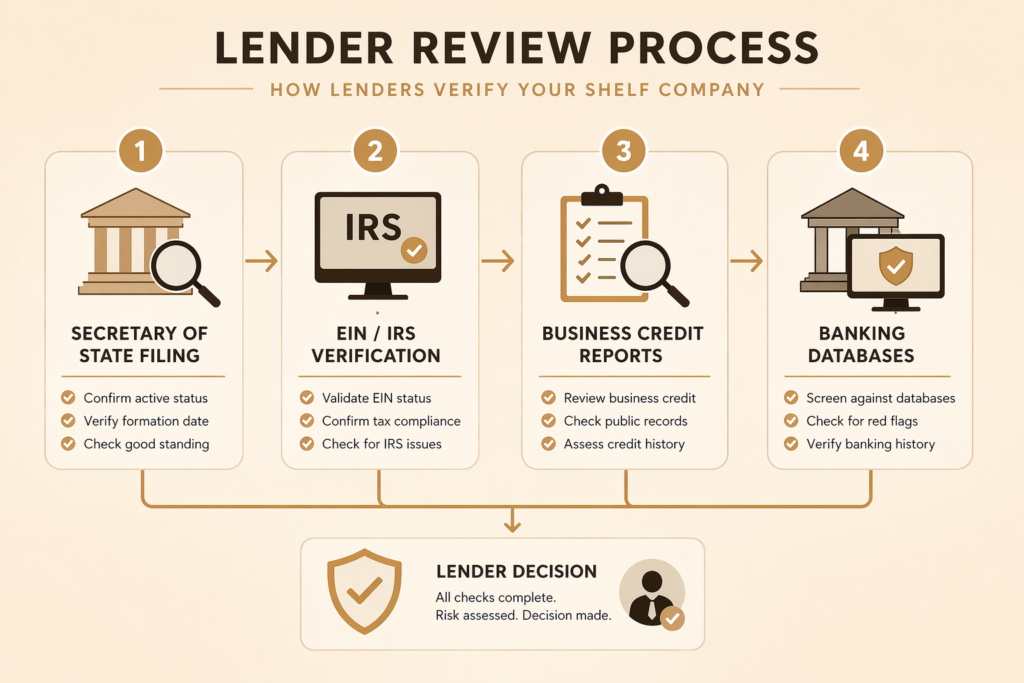
Most borrowers assume lenders just check personal credit scores and bank statements. In reality, lenders run a far more thorough review of the business entity itself, especially when the company appears to have a history. Here is what that process typically looks like:
| What Lenders Check | What They’re Looking For | Clean vs. Dirty Outcome |
| Secretary of State Filing | Formation date, current standing, officer history | Clean: passes instantly. Dirty: dissolved/reinstated history flagged. |
| Business Credit Reports | Experian Business, Equifax Business, and Dun & Bradstreet payment history | Clean: no file or blank profile. Dirty: derogatory tradelines or collections. |
| EIN/IRS Records | Prior tax filing history, 1099 usage, payroll records | Clean: zero usage. Dirty: unfiled returns or tax debt attached. |
| Commercial Databases | LexisNexis, CLEAR, and Dun & Bradstreet for any business activity | Clean: no entries. Dirty: activity flags trigger manual review. |
| Banking Databases | ChexSystems, EWS for prior account history | Clean: no file. Dirty: prior NSF history or closed accounts flagged. |
| Registered Agent & Officer History | Prior owners, associated entities, and public record searches | Clean: original incorporation only. Dirty: prior owner risk associations. |
Why a New EIN After Transfer Is Non-Negotiable
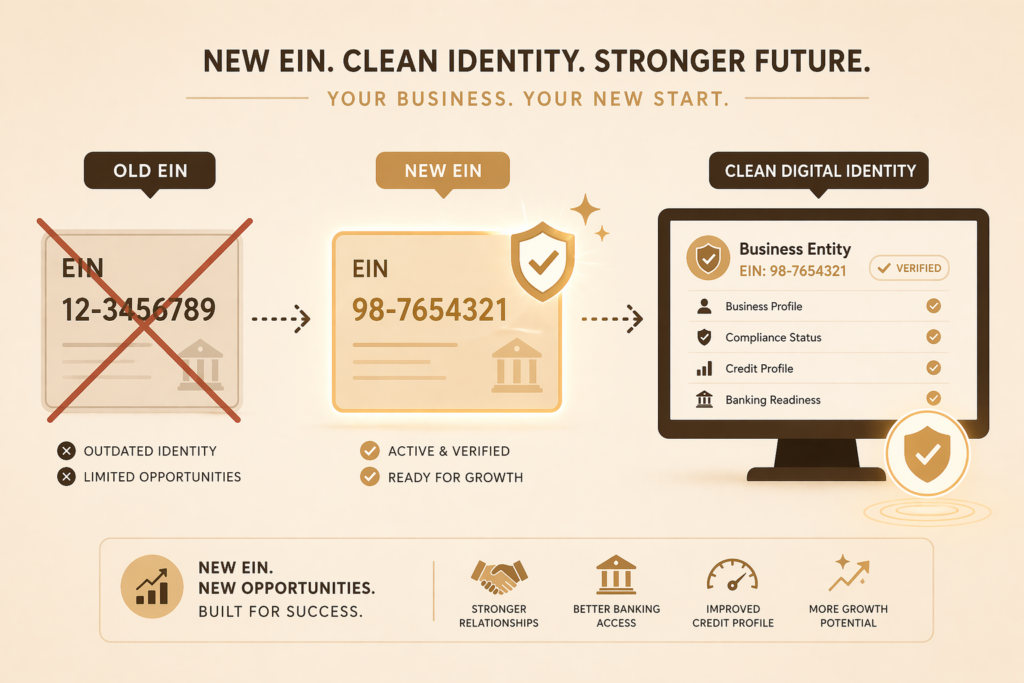
One of the most overlooked steps in any shelf company transfer is obtaining a new Employer Identification Number after the ownership change. Many sellers skip this entirely. That is a serious problem.
Even if the original EIN shows no activity, keeping it after the transfer leaves you exposed to any future discoveries tied to that number. A new EIN gives your business a clean, fresh identity in IRS and banking systems, completely separated from whatever history the original EIN may carry, known or unknown.
This is a step that reputable aged corporation providers like Tradeline Associates include as a standard part of every transfer. If your provider does not offer this, consider it a major warning sign.
How Modern Lenders Use AI and Data Aggregation to Catch Dirty Shelf Corporations
This is not 2010 anymore. Lenders are not manually calling state agencies to verify your business history. They are using sophisticated, automated systems that cross-reference dozens of data sources in seconds.
Platforms like LexisNexis Risk Solutions aggregate court records, property filings, business registrations, bankruptcy records, and UCC filings into a single risk profile. Dun & Bradstreet’s Paydex score and DUNS number system tracks payment behavior across millions of businesses. Equifax Business and Experian Business maintain credit files that lenders access through automated decisioning engines.
When you submit a business funding application, your company’s information is run through these systems automatically, often before a human reviewer ever looks at your file. A dirty shelf corporation leaves breadcrumbs in these systems that the algorithm will flag, and once flagged, it is extremely difficult to reverse the decision.
| Important: Google’s AI Overview and major search engines now surface business registry information, litigation records, and public filings as part of AI-generated summaries. This means your business’s public footprint matters not just for lenders, but for any potential partner, investor, or client who searches for you. |
The Real Benefits of a Clean Aged Shelf Company Done Right
Immediate Time-in-Business Credibility
The most significant benefit is straightforward: you bypass the one-to-two-year waiting period most lenders impose on new businesses. From day one of ownership, your company legally has a history, real, verifiable, state-filed history that matches what lenders need to see.
A Blank Canvas for Building Business Credit
A clean aged entity means your business credit profile starts with zero negative information. You can begin building your Dun & Bradstreet DUNS profile, your Experian Business credit file, and your Equifax Business score from scratch, without any inherited baggage pulling you down.
Legitimacy That Holds Up to Scrutiny
Because the formation date is real and the state filing is real, there is nothing to hide or explain away. When a lender pulls your Secretary of State records, they see exactly what you claim. That consistency builds confidence in your application and reduces the risk of a fraud review.
Faster Access to Business Funding Tiers
With time-in-business established, you qualify for funding products that are simply unavailable to startups: business lines of credit, SBA loans, equipment financing, and corporate credit cards with meaningful limits. These are the tools that actually let you grow, not the predatory microloans aimed at desperate new businesses.
How to Vet a Shelf Company Before You Buy: A Practical Checklist
Not every shelf company seller operates with the same level of due diligence. Before transferring any aged entity, run through this checklist to protect yourself:
- Request the original Certificate of Formation or Articles of Incorporation and verify it directly on the Secretary of State’s website. Do not take the seller’s word for it.
- Run the EIN through a basic IRS verification. Ask the seller to confirm that no tax returns have been filed under that EIN. Any reputable provider should be able to produce this documentation.
- Search the company name in LexisNexis, Dun & Bradstreet, and your state’s UCC filing system. Look for any liens, judgments, or registered financing statements attached to the entity.
- Ask specifically about prior officers and registered agents. Run a background check on prior owners if the seller will disclose them. Prior associations with fraud or debarment can follow the company.
- Confirm the provider will issue a new EIN post-transfer. This is a non-negotiable step for truly clean business credit building.
- Get a written representation and warranty from the seller that the entity has had zero prior activity. If they refuse, walk away.
How Tradeline Associates Maintains Clean Shelf Companies

At Tradeline Associates, every aged shelf company available for transfer has been maintained under a strict dormancy protocol from the date of formation. That means no EIN usage, no bank accounts, no vendor registrations, no activity of any kind, period.
Every transfer comes with complete formation documentation, current good-standing certification, and full disclosure of the entity’s history before any money changes hands. There are no surprises after the fact because the documentation is provided upfront.
The new EIN issuance is included in every transfer as a standard step, not an upsell. Because we understand that your ability to build a clean business credit profile depends on a completely fresh start in every database that lenders use.
We also provide guidance on the next steps after transfer: how to establish your DUNS number, how to open a business bank account under the new EIN, how to begin building trade credit relationships, and how to structure your first funding applications for the highest possible approval probability.
Frequently Asked Questions About Clean Aged Shelf Companies
Is using an aged shelf company legal?
Yes. Transferring ownership of a legally formed corporation is a standard and fully legal business transaction. The company’s formation date reflects when it was genuinely incorporated, not when you took ownership. There is nothing deceptive about this; it is the same principle behind buying any established business.
What is the difference between a shelf company and a shell company?
A shelf company is a real legal entity that was formed and then kept dormant, waiting to be transferred. A shell company is typically formed specifically to hold assets, conduct specific transactions, or obscure ownership structures. The two terms are often confused, but they are not the same thing. A clean aged shelf company is a legitimate business tool. A shell company, depending on how it is used, can raise compliance and regulatory concerns.
Will lenders see the original formation date on my shelf company?
Yes, and that is exactly the point. The formation date on file with the Secretary of State is what lenders use to verify time in business. A clean aged shelf company gives you a real, verifiable formation date that meets lender requirements without any fabrication.
How long does it take to start building business credit after a shelf company transfers?
With the right steps, a new EIN issued, a business bank account opened, a DUNS number established, and initial net-30 vendor accounts set up, most businesses begin to see a functioning Dun & Bradstreet profile within 30 to 60 days. Meaningful business credit scores typically develop over three to six months of consistent payment history.
What happens if I buy a dirty shelf company by mistake?
Unfortunately, the damage is difficult to undo. Once you have taken ownership of an entity with hidden liabilities, you are legally responsible for its history. IRS debts, UCC liens, and commercial database flags follow the EIN and entity name regardless of ownership changes. In most cases, the best option is to dissolve the entity and form a new company, which means losing the time-in-business benefit you paid for.
How do I know if a shelf company provider is reputable?
Look for providers who offer full documentation before payment, include a new EIN in the transfer process, provide written representations about prior activity, and have verifiable testimonials or references from past clients. Avoid any provider who cannot or will not show you the original formation documents, or who is vague about the entity’s prior history.
The Bottom Line: Clean Is the Only Version That Works
The business funding landscape is more data-driven than ever. Lenders are not guessing. They are using real systems, real databases, and increasingly sophisticated AI-driven risk models to evaluate every entity that applies for credit.
A clean aged shelf company, properly transferred and documented, gives you a genuine competitive advantage, legitimate time-in-business credibility that opens doors that would otherwise be closed to you for years. But only if it is actually clean.
A dirty shelf corporation does not just fail to help you. It actively hurts you, triggering denials, fraud reviews, and database flags that can follow your business for years.
The difference between the two is not always visible on the surface. That is why it matters who you buy from, what documentation they provide, and what verification steps they follow before and after the transfer.
If you are serious about using an aged entity to build your business funding profile, do it right the first time. The cost of getting it wrong is far higher than the cost of doing it correctly.