Business Credit Bureaus Explained: D&B, Experian, Equifax, and SBFE
Most business owners know the personal credit bureaus, Equifax, Experian, and TransUnion. They check their scores, dispute errors, and work to understand what moves the number. What very few of them realize is that there is an entirely separate credit reporting system built specifically for businesses, and most people who get denied for funding have no real profile in it.
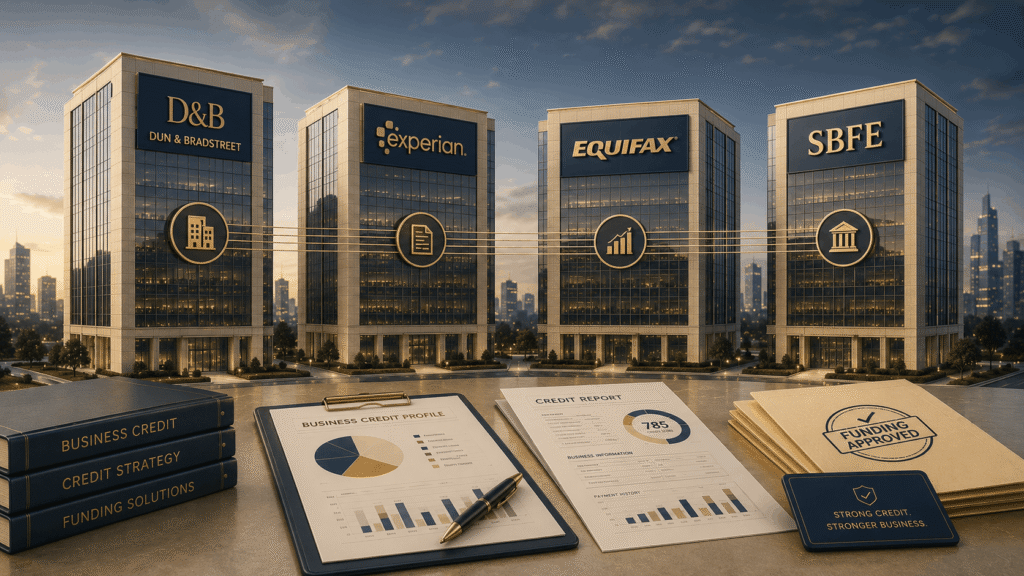
Getting business credit bureaus explained properly is not just academic. Different lenders pull different bureaus. A bank may reference D&B as its primary source. An online lender may check Experian Business. A bank that is a member of the Small Business Financial Exchange will pull SBFE data. If your profile is strong in one bureau and empty in another, you will qualify with some lenders and get rejected by others, without ever understanding why.
This guide covers all four major commercial credit bureaus, what each one measures, how lenders actually use them, according to NerdWallet’s business credit research, and the exact steps to build a presence across all of them.
Why Business Credit Bureaus Work Differently Than Personal Credit
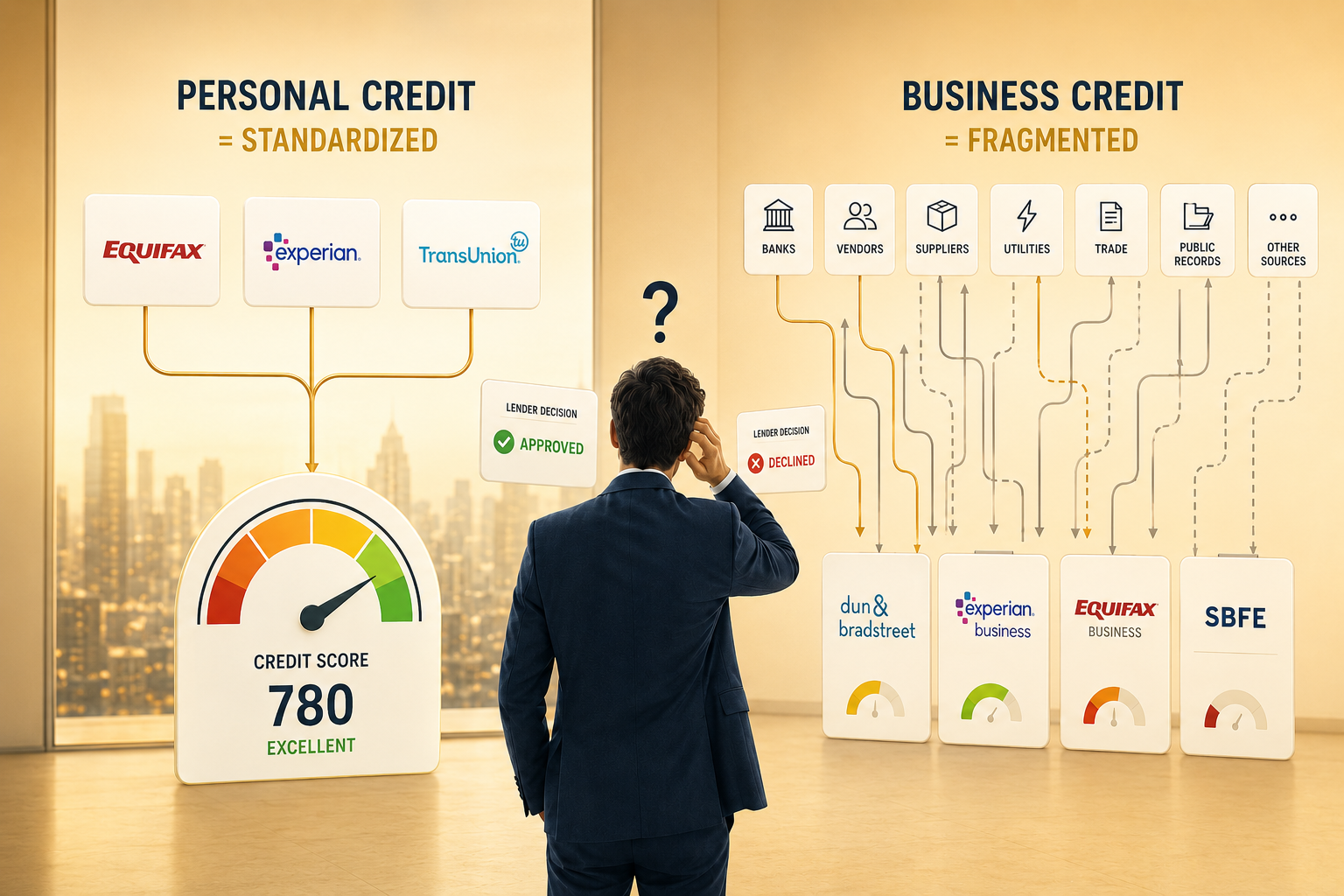
Personal credit is relatively standardized. Lenders report to Equifax, Experian, and TransUnion automatically. Scores follow the widely understood FICO model. The system is consumer-protective by design.
Business credit does not work that way. Reporting to commercial bureaus is voluntary, not automatic. A vendor can choose to report your payment history to Dun & Bradstreet or keep it internal. A bank can report your loan data to SBFE member bureaus, or not. This means your business credit profile is only as complete as the accounts that have been actively reported — and many business owners have thin or empty commercial credit files without realizing it.
According to Nav’s commercial credit research, each bureau uses different scoring models and data sources, which means your scores can vary significantly between them. Regularly monitoring all four and building activity across each one is the only way to ensure you are visible to every type of lender.
The 4 Business Credit Bureaus Explained: A Full Comparison
Here is how all four bureaus compare across the factors that matter most to your funding applications:
| Factor | D&B | Experian Business | Equifax Business | SBFE |
| Primary Score | Paydex (0–100) | Intelliscore Plus (1–100) | Payment Index + Risk Score | No score, data only |
| Good Score Threshold | 80+ | 76+ | 90+ Payment Index | N/A |
| Main Data Source | Trade vendors, SBRI | Lenders, public records, trade | SBFE data + public records | Bank lenders only |
| Who Uses It | Vendors, lenders, govt | Banks, online lenders | Banks, credit unions | SBFE member banks |
| Can You Build It? | Yes, net-30 vendors | Yes, trade + lender accounts | Yes, credit cards + loans | Only via bank lenders |
| Free to Register? | Yes, DUNS free | No free report | The report costs $49.95 | No direct access |
| Business Age Factor | Yes | Yes (in score) | Yes | Yes (lender data) |
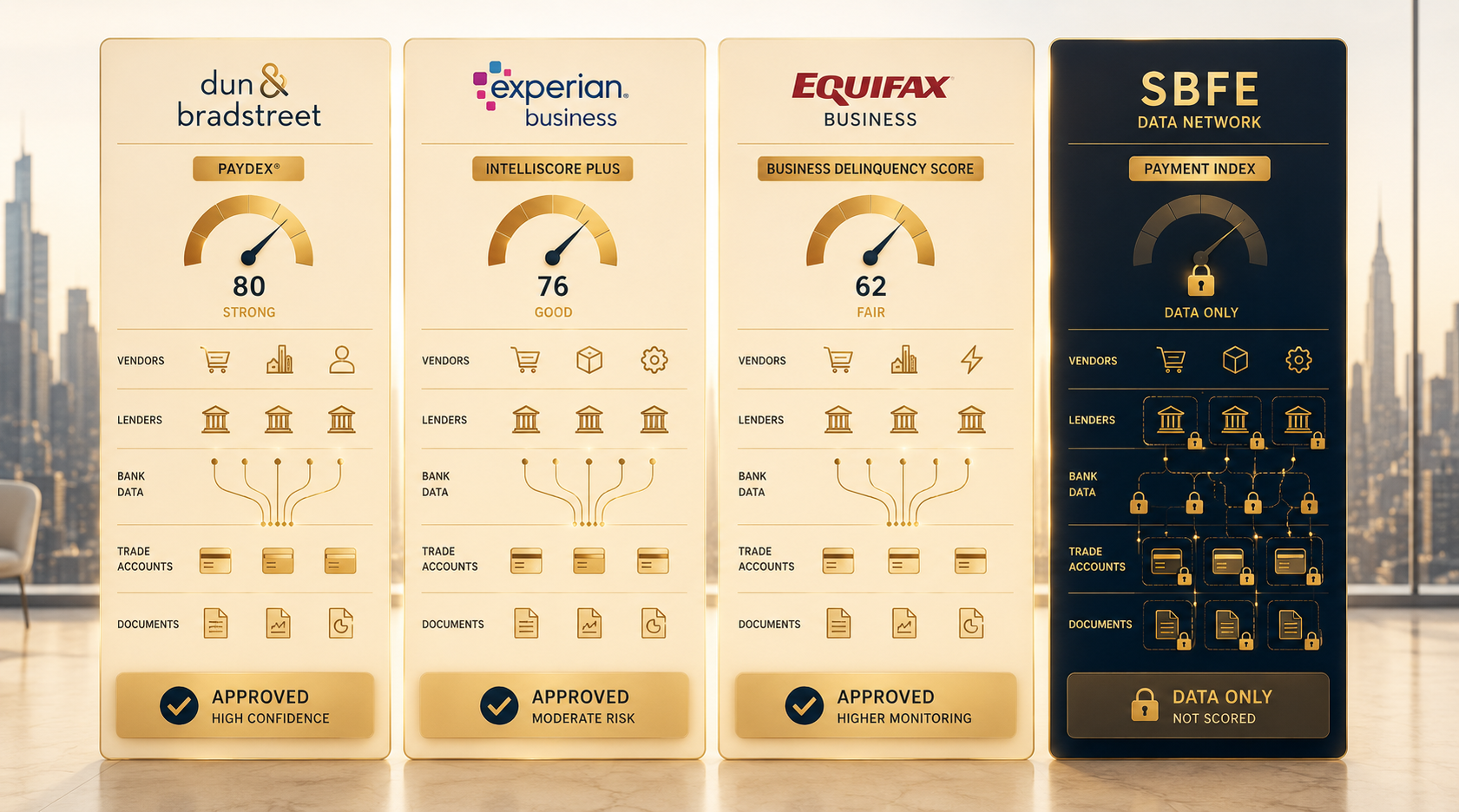
Key insight: No single bureau covers everything. D&B is best for vendor credit and government contracts. Experian Business is used by a wide range of online and traditional lenders. Equifax Business is critical for business credit cards. SBFE data feeds bank underwriting decisions. You need a presence across all four.
Dun & Bradstreet: The Foundation of Business Credit
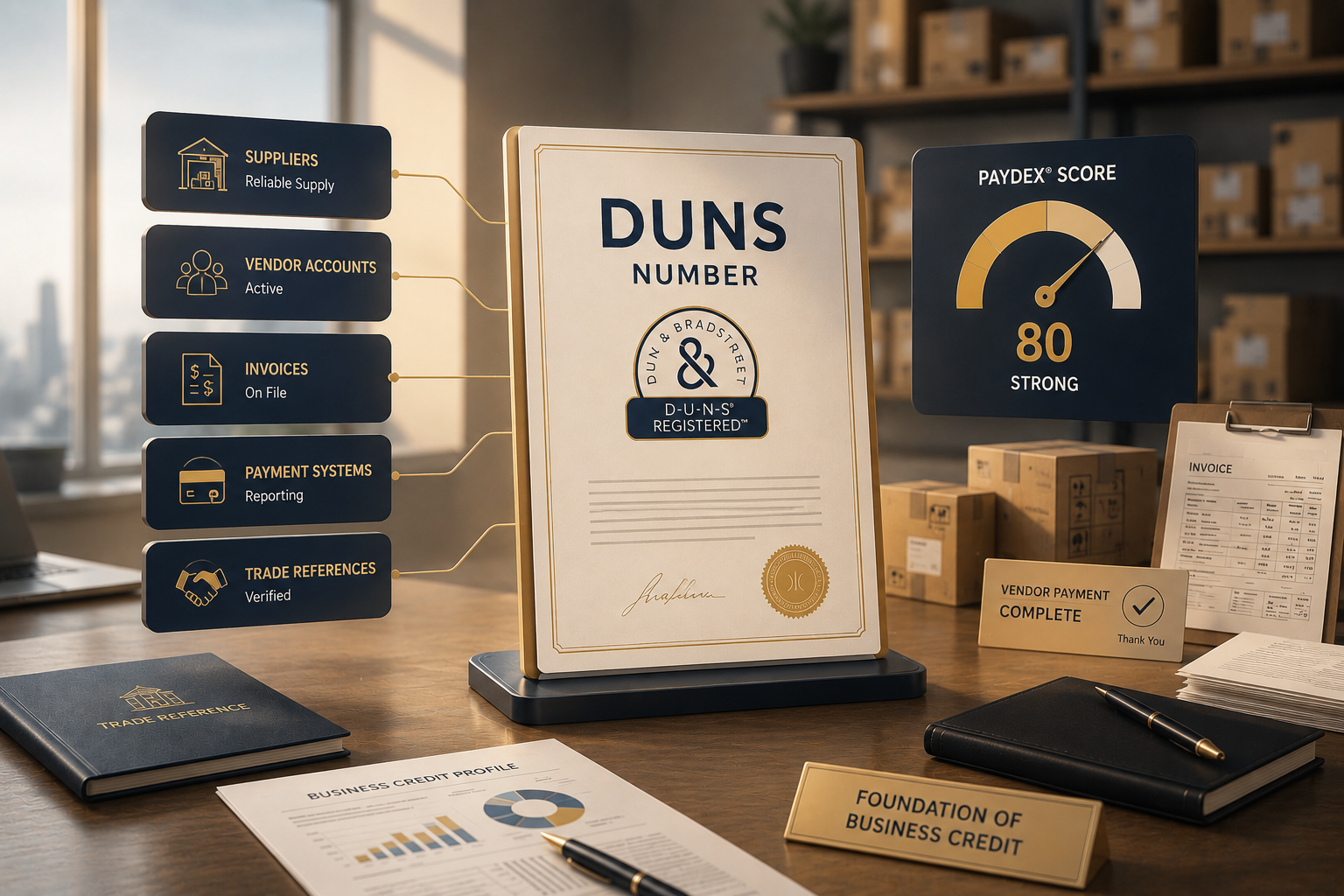
Dun & Bradstreet is the oldest and most widely recognized commercial credit bureau in the world, founded in 1841. Your D&B profile is built around your DUNS number, a unique nine-digit identifier assigned to your business. Without one, your business is essentially invisible to any lender, vendor, or government agency that uses D&B as its primary reference.
The primary D&B score most lenders reference is the Paydex score, which runs from 0 to 100 and measures how consistently your business pays its bills. A score of 80 or above indicates on-time payment and is considered the standard benchmark for good commercial credit. Paying invoices before the due date, not just on time, is what pushes scores toward 90 and above.
How to Build Your D&B Profile
D&B mostly relies on trade vendor accounts, which are relationships with suppliers where you buy things on net-30 terms, and the seller tells D&B about your payment history. Well-known starter vendors include Uline, Quill, Grainger, and Summa Office Supplies. Three to five actively reporting vendor accounts, paid consistently early, will establish a Paydex score within approximately three months.
Registering your DUNS number is free. Visit Dun & Bradstreet’s website directly and complete the registration. It typically takes a few business days to process. Once active, verify that every detail in your D&B profile matches your Secretary of State filing and business bank account exactly. Automated lender verification systems have trouble when your D&B description doesn’t match up with other records. For more on avoiding these errors, see our guide: [Internal Link: Hidden Compliance Issues That Get Businesses Denied].
Experian Business: The Lender’s Secondary Check
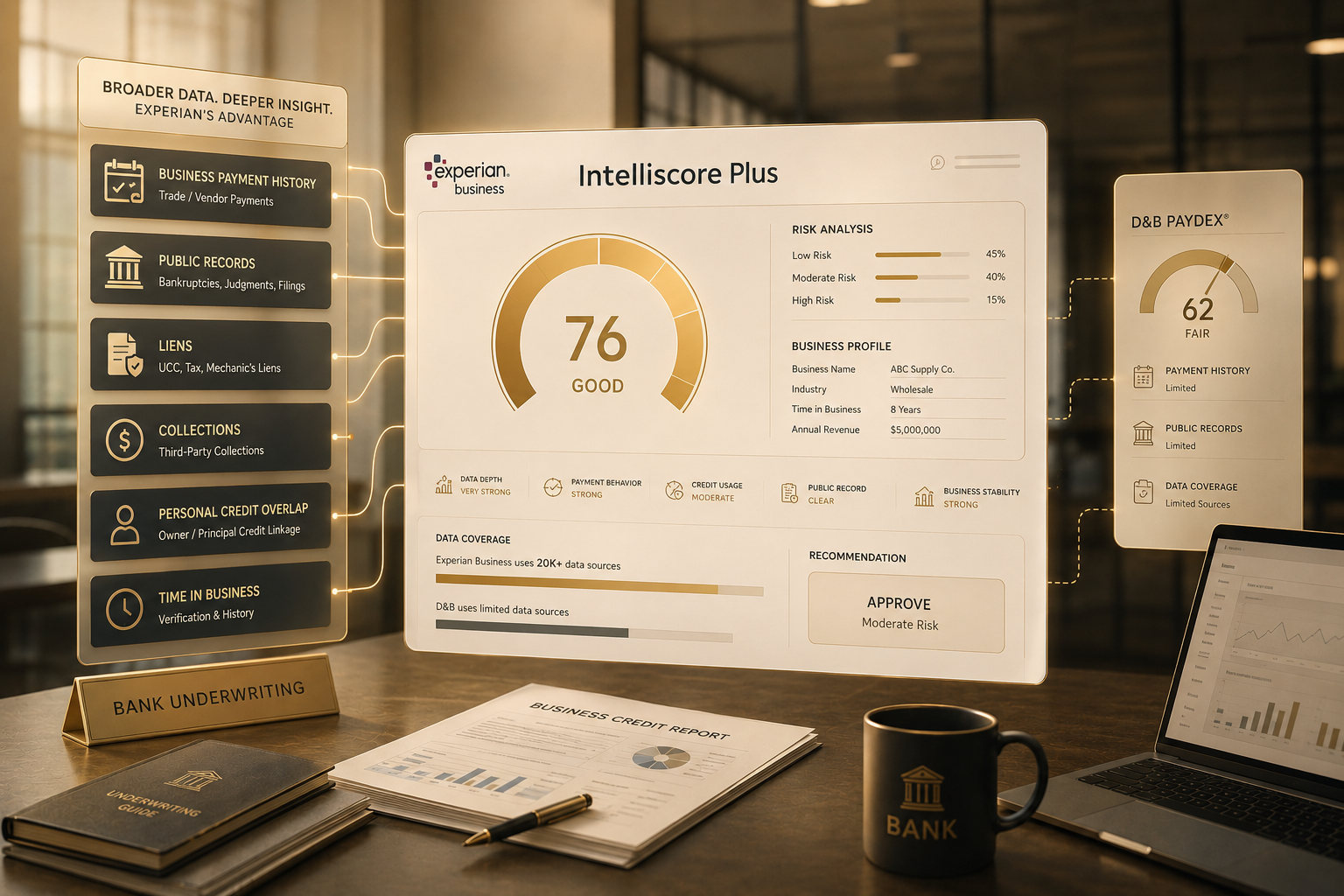
Experian Business is used by a wide range of lenders, banks, credit unions, and online lenders as either a primary or secondary commercial credit reference. Its main scoring model is the Intelliscore Plus, which runs from 1 to 100. A score above 76 is generally considered low-risk. Unlike D&B, Experian Business pulls from a broader set of data sources, including trade payment history, public records like liens and judgments, banking data, and collection accounts.
One important distinction: Experian Business also incorporates personal credit data for small businesses under certain revenue thresholds. Your personal credit score can influence your Experian Business score. This is why both your personal and business credit profiles need to be in good shape; they are not evaluated in isolation at Experian.
According to SCORE’s bureau research, Experian also factors in time in business, the size of your business, and your SIC code into its scoring. A newly formed entity will have a weaker Experian profile, not just because of thin payment history, but because the formation date itself is a scored variable.
Equifax Business: Critical for Credit Cards and Bank Products
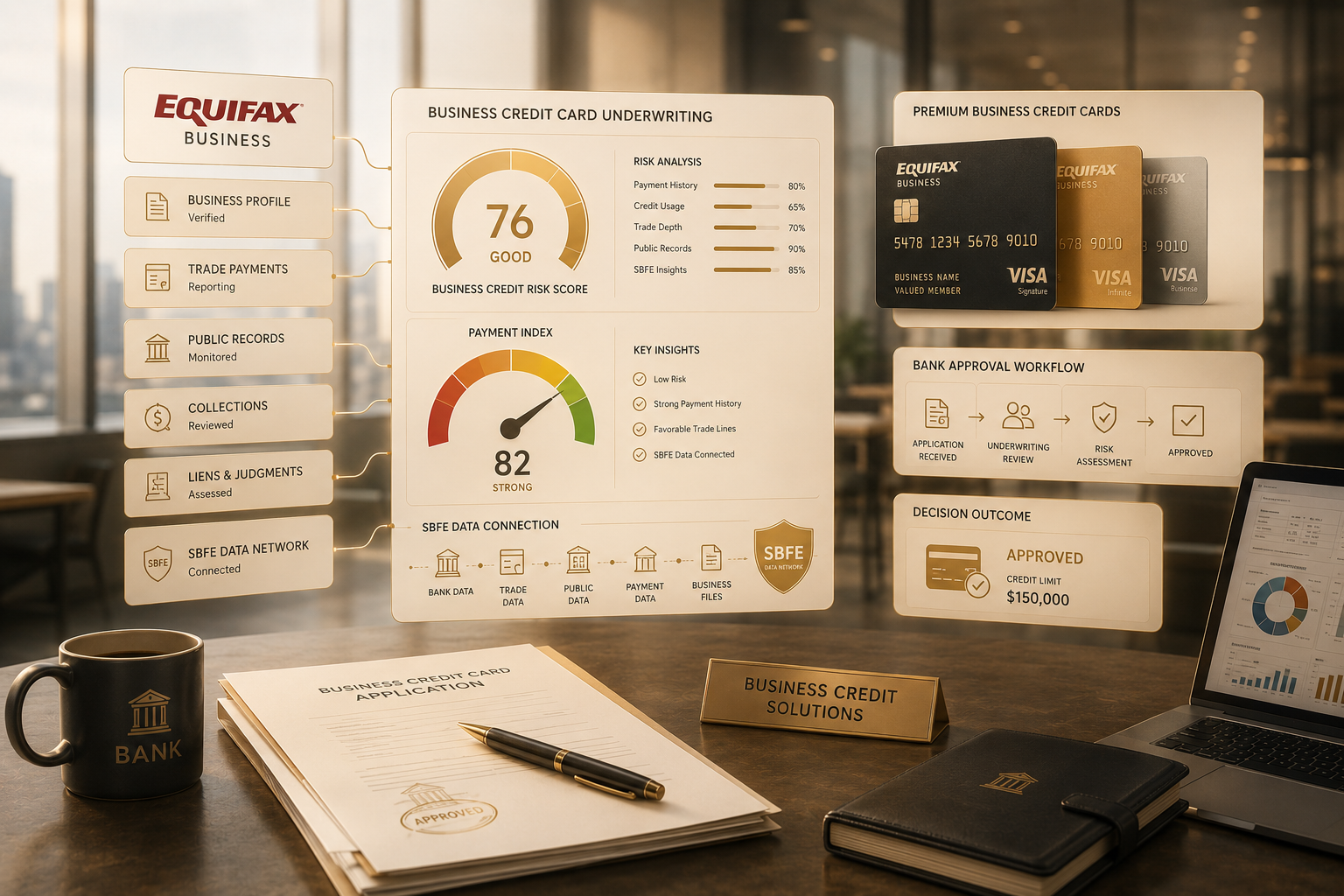
Equifax Business rounds out the major commercial bureaus and is particularly important for business credit card approvals. Many business credit card issuers, including Capital One, which reports Spark Business card data to D&B, Experian, Equifax, and SBFE simultaneously, rely on Equifax Business for underwriting decisions.
Equifax Business takes a multi-score approach rather than relying on a single headline number. It uses a Payment Index (0–100, higher is better) alongside a Business Credit Risk Score and a Business Failure Score. Each metric evaluates a different dimension of risk. Lenders using Equifax may weigh these scores differently depending on the product they are underwriting.
Equifax Business incorporates SBFE data into its reports, meaning payment history on business loans and credit products from SBFE member financial institutions feeds into your Equifax Business profile. This is why consistent, on-time payments on your business bank products are important even beyond the D&B Paydex relationship.
SBFE: The Bureau Most Business Owners Have Never Heard Of
In 2001, the Small Business Financial Exchange (SBFE) was set up as a member-owned data exchange. Banks and financial institutions that are SBFE members report business loan, credit card, and equipment lease payment data into the SBFE database. Other member lenders then access that data when evaluating new applications.
What makes the SBFE unique and confusing is that it does not create credit scores or sell credit reports directly. Instead, it provides data exclusively to approved commercial bureau partners, D&B, Experian, Equifax, and LexisNexis Risk Solutions, who incorporate it into their own scoring models. You cannot check your SBFE profile yourself, and you cannot build it through vendor accounts. The only way SBFE data gets created is through payment history on accounts with member financial institutions.
The opt-in problem: Business credit card reporting is not automatic. According to eCredible’s 2025 issuer matrix, only three of the eight largest business card banks, Capital One, Chase, and Citi, send positive payment history to D&B. Many issuers route data through SBFE instead, which updates less predictably. There is no need to swipe a card every day for a whole year if the card owner does not directly report to D&B.
How Business Age Affects All Four Bureau Profiles
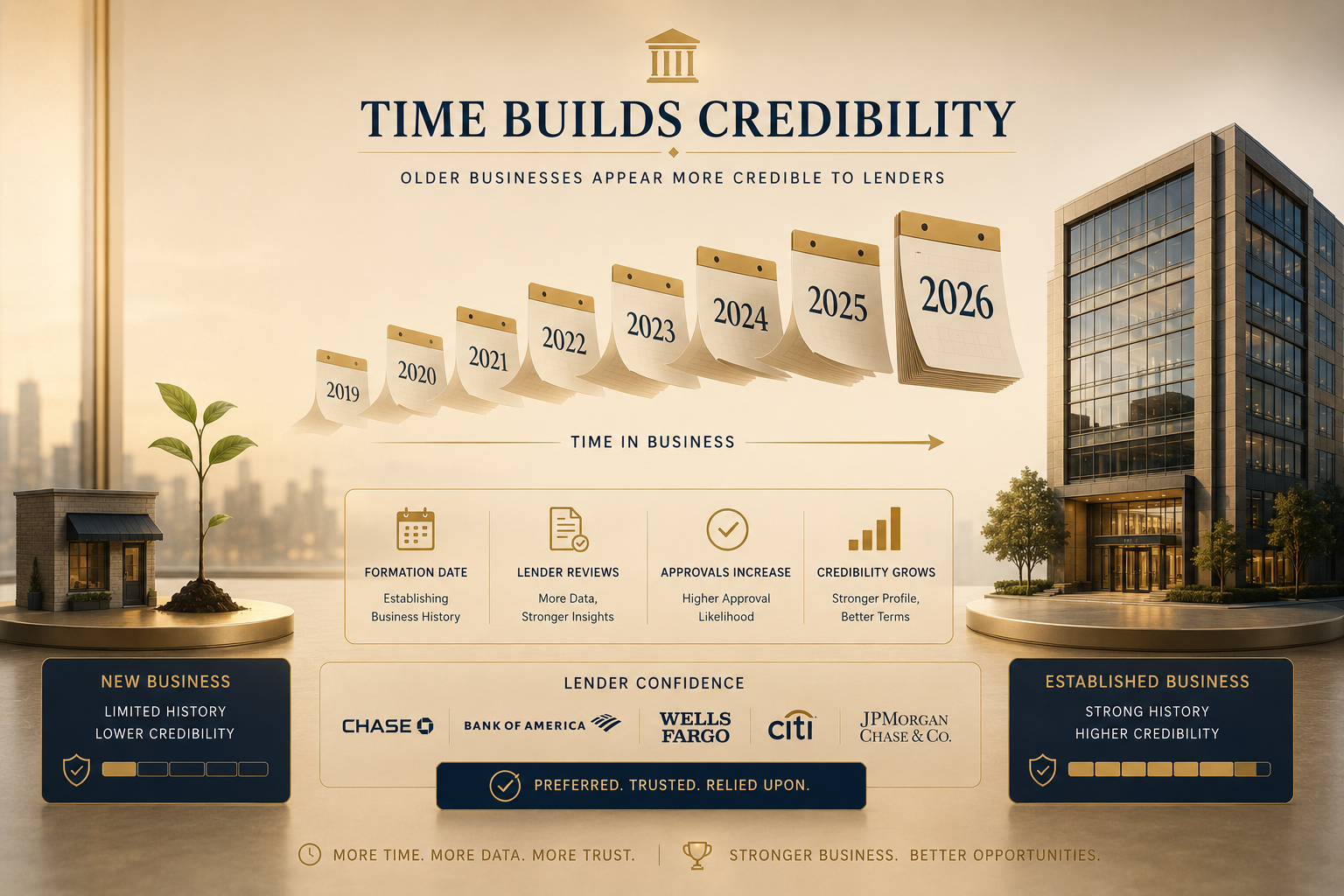
Every commercial bureau factors in how long your business has been operating. A recently formed entity will have thin files across all four bureaus, regardless of how aggressively you try to build trade accounts. Business age is a scored variable at Experian, a data point at D&B, and a factor in SBFE lender risk models.
This is one of the reasons a clean-aged shelf company changes the credit-building equation. An entity with a longer formation date starts with a more credible base across every bureau that checks it. You are not presenting a zero-month-old entity trying to build credibility from scratch — you are building on a foundation that already carries weight simply because of the date on the state filing. Learn more in our guide: How Aged Shelf Companies Help with Business Funding
A Real Scenario: Strong D&B Score, Invisible Everywhere Else
Kevin runs a small logistics company. He spent eight months building a Paydex score of 82 through net-30 vendor accounts. He was proud of the number and confident going into his first bank loan application. Denied. An underwriting system at the bank checked Experian Business but found no profile at all. Kevin had only built D&B and had never started a business credit account that Experian would see. His Equifax Business file was equally empty. He spent the next three months opening a secured business credit card (Capital One Spark, which reports to all four bureaus) and two additional vendor accounts that reported specifically to Experian. Six months later, with active profiles at D&B, Experian, and Equifax, he was approved.

Kevin’s mistake is one of the most common in business credit building, optimizing for one bureau while the others stay empty. Lenders do not all use the same bureau. You need a presence everywhere.
How to Build a Profile Across All Four Business Credit Bureaus
Use this table as your action plan. Each bureau requires a slightly different approach:
| Bureau | Best Way to Build a Profile | Timeline to First Score |
| D&B (Paydex) | Register DUNS → Apply for net-30 vendor accounts (Uline, Grainger, Quill) → Pay early | 3 accounts reporting = ~3 months |
| Experian Business | Net-30 vendors + business credit cards that report to Experian → pay on time | 2–3 months with active accounts |
| Equifax Business | Business credit cards (Capital One Spark reports to Equifax) + business loans | 3–6 months of account history |
| SBFE | Open business accounts with SBFE member banks → get business loans/credit cards → pay on time | Depends on lender reporting |
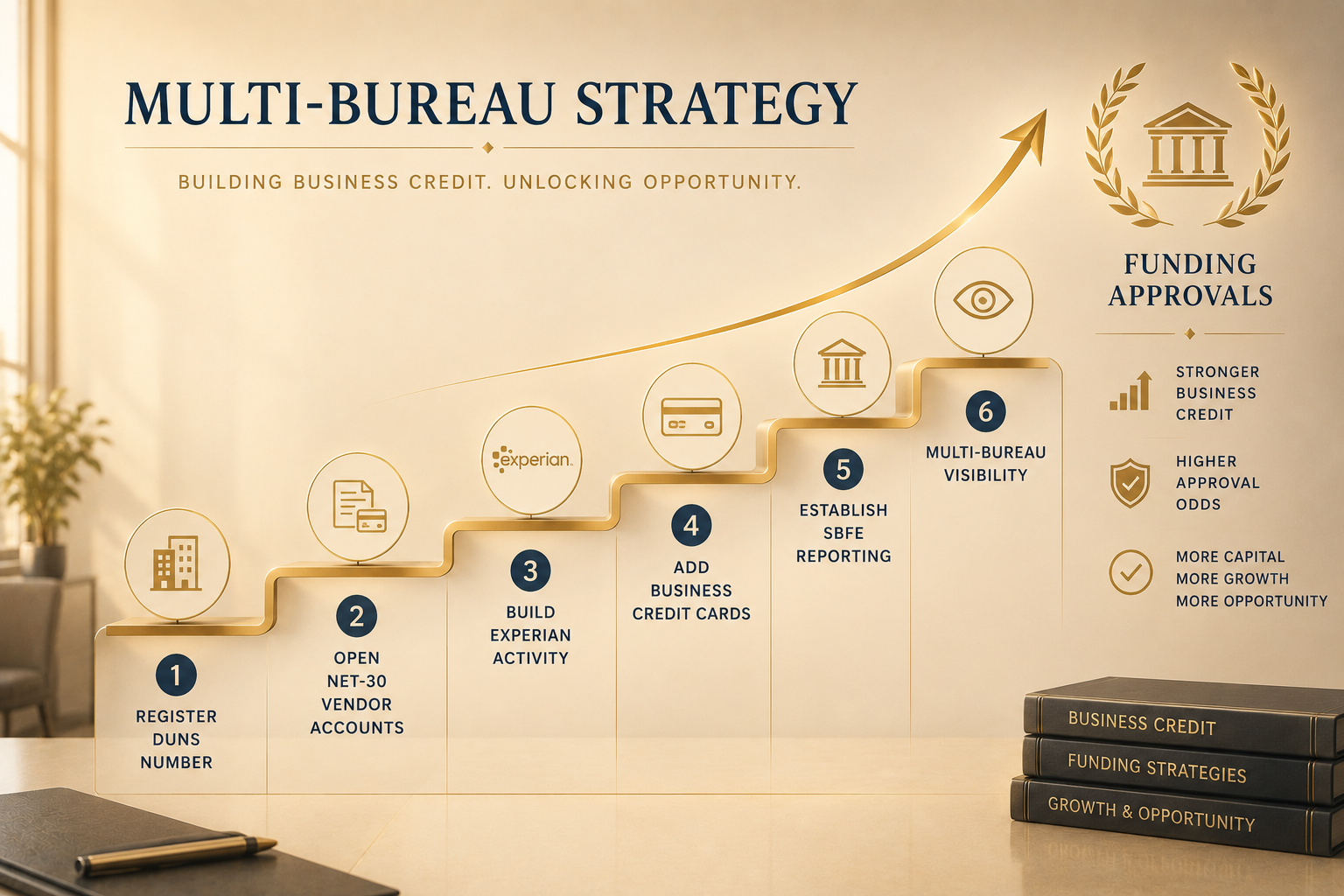
Priority order: Start with D&B (register your DUNS number first — it is free and fast). Then open vendor accounts that report to both D&B and Experian simultaneously. Add a business credit card from Capital One or Chase that reports to all four bureaus. Keep every payment early. Consistency over 90 days builds more credibility than volume.
The Most Important Rules for All Four Bureaus
- Pay every account early, not just on time. The Paydex score rewards early payment specifically. A payment made one day before the due date scores the same as one made on the due date. A payment made 30 days before the due date scores significantly higher. Most business owners don’t understand how important this difference is.
- Keep your business information identical across every bureau. Your business name, address, phone number, and EIN should appear identically in your D&B profile, your Experian Business listing, your Equifax Business file, and your bank records. A mismatch between any two sources raises flags in automated lender systems and can cause a denial even when your scores are strong.
- Monitor all four regularly — errors are common. Commercial credit report errors are more prevalent than most business owners know. Incorrect payment history, outdated addresses, or mislinked accounts can suppress your scores without any action on your part. Check each bureau at least quarterly and dispute any inaccuracies immediately.
Frequently Asked Questions
Which business credit bureau do most lenders check?
There is no single universal answer; it depends on the lender. Most of the time, traditional banks use statistics from D&B and SBFE. Online lenders frequently pull Experian Business. Credit card issuers tend to use Equifax Business. The safest strategy is to build a profile across all four, so you are visible regardless of which bureau your lender prefers.
Can I build credit for my business even though I don’t have a DUNS number?
You can open vendor accounts and business credit cards, but without a DUNS number, your D&B profile does not exist — and D&B is referenced by more lenders, vendors, and government agencies than any other commercial bureau. Registering your DUNS number is free and takes a few business days. It is the single most important first step in building any commercial credit profile.
How long does it take to build a business credit score?
With three to five actively reporting vendor accounts, consistent early payments, and a registered DUNS number, most business owners see their first Paydex score appear within 60 to 90 days. Experian and Equifax Business profiles typically take two to four months of active account history. Building scores that are strong enough to unlock meaningful credit lines generally takes six to twelve months of deliberate, consistent activity across multiple bureaus.
Does my business credit score depend on my personal credit score?
At Experian Business, yes — personal credit data is incorporated into the Intelliscore Plus score for small businesses below certain revenue thresholds. D&B’s Paydex score is based purely on business payment history and does not factor in personal credit. Equifax Business and SBFE data are generally business-only, though lenders may run a personal credit check separately as part of their underwriting process.
What is the SBFE and how does it affect my funding?
The SBFE is a members-only data cooperative where banks share business loan and credit payment data with each other. You can’t get scores or reports directly from it; instead, it sends information to D&B, Experian, Equifax, and LexisNexis.. If you have never had a business loan or credit product with an SBFE member bank, your SBFE data file may be empty, which limits what bank lenders can verify about your payment history.
The Bottom Line: Be Visible Everywhere
Having the business credit bureaus explained is the first step — but understanding them only matters if you act on it. Most business owners who struggle to get funded are not doing anything wrong. They simply built in one place while staying invisible everywhere else.
Register your DUNS number. Build vendor accounts that report to D&B and Experian. Open a business credit card from an issuer that reports to all four bureaus. Pay everything early. Keep your business information perfectly consistent across every bureau and every database a lender might check.
Done consistently over six to twelve months, this approach builds the kind of multi-bureau commercial credit profile that makes lenders confident — and makes approvals far more likely, regardless of which bureau they happen to check first.
[Internal Link: How to Build a Fundable Business Profile] | [Internal Link: Aged Shelf Companies for Business Funding]
Sources & Further Reading
- Nav — Business Credit Bureaus: What They Are and How They Work
- NerdWallet — Business Credit Scores: What They Are and How to Check Yours
- SCORE — Understanding the Three Major Business Credit Bureaus
- Bank of America — Credit Score Basics for Small Businesses
- Ramp — The 3 Major Business Credit Bureaus and How They Work
- Nav — What Is the Small Business Financial Exchange?
- Payline Data — Secured Business Credit Cards That Report to D&B