
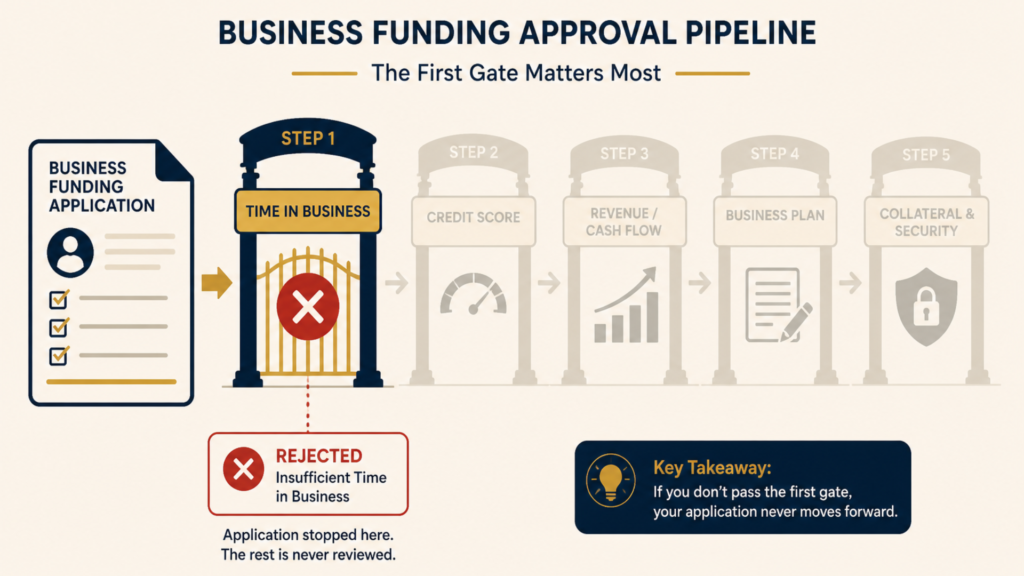
You applied for business funding. Maybe your credit score was solid. Your plan was clear. Your numbers made sense. And you still got denied, not because you were unqualified, but because your business was six months old and the lender’s system never got past that fact.
This is one of the most misunderstood problems in small business finance. Most owners assume funding is mostly about personal credit. In reality, lenders evaluate an entire profile, and the first thing many of them check is how long your business has existed. If it has not existed long enough, the rest of your application is never read.
Knowing how to build business credibility for funding means understanding what lenders actually look for, which problems you can solve quickly, and which ones take time. This guide covers all of it, including the role a clean shelf corporation can play in dramatically compressing your timeline.
What Business Credibility for Funding Actually Means
Business credibility is not a single score or a single document. To a lender, it is the sum of multiple signals, all evaluated together to determine how risky it is to put money into your business. The U.S. Small Business Administration identifies five core factors lenders use to assess business credit: the character of the ownership, the capacity to repay, the capital invested, available collateral, and the broader conditions of the business environment.
But beneath all five of those factors sits a preliminary filter that most business owners never see coming: business entity age. Before lenders evaluate any of those five factors, many of them confirm whether your business has been operating long enough to qualify for their program at all.
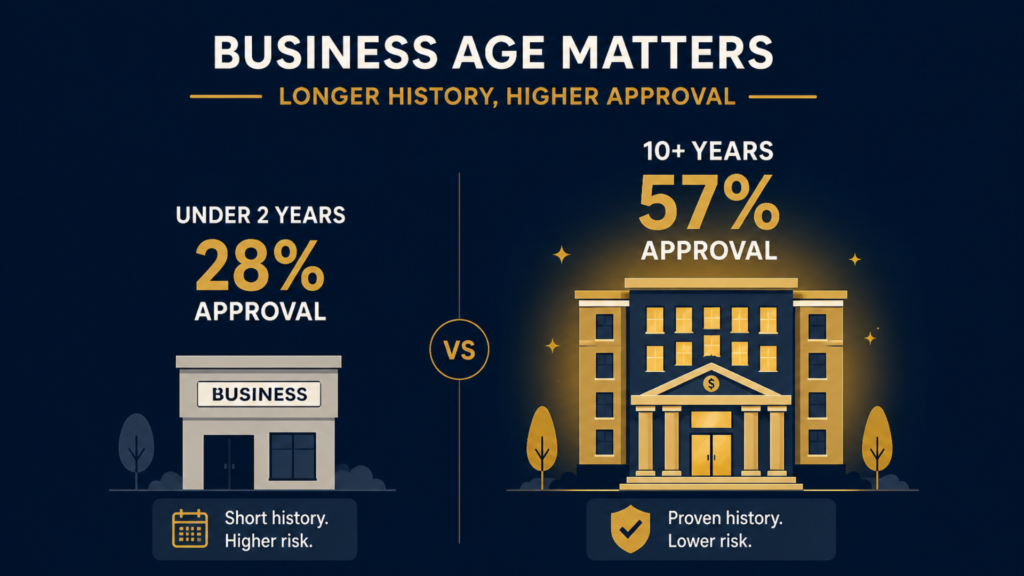
According to the Federal Reserve’s 2025 Small Business Credit Survey, firms less than two years old had a full-funding approval rate of only 28%, compared to 57% for firms with ten or more years of history. That is not a small gap. It is the difference between being taken seriously and being dismissed before anyone looks at your application.
Why Personal Credit Alone Is Not Enough
Here is the critical thing most business owners miss: personal credit score and time in business are evaluated separately. You can have a 750 credit score and still be rejected because your entity was formed ninety days ago. The age check happens first. If you do not clear it, the rest of your application, your credit score, your revenue, and your business plan will never be reviewed.
This is why so many qualified business owners feel stuck. They keep working on personal credit while the real barrier goes completely unaddressed. To genuinely build business credibility for funding, you need to tackle the age problem directly.
The Complete Picture: What Lenders Check Before Approving Funding
Understanding every factor lenders evaluate helps you prioritize where to focus. The table below shows exactly what lenders look at, what each factor measures, and the fastest path to building credibility in each area:
| Lender Factor | What It Measures | How to Build Credibility Here |
| Time in Business | Entity stability & survival odds | Clean aged shelf company, instant |
| Personal Credit Score | Owner’s repayment track record | Built in parallel, 650+ target |
| Business Credit Profile | The company’s own payment history | Net-30 vendors + Paydex score |
| Cash Flow / Revenue | Ability to repay debt | Real banking activity is required |
| Business Identity (EIN, address, licenses) | Operational legitimacy | Proper entity setup after transfer |
| Collateral | Security if the business defaults | Separate asset requirement |
Key takeaway: Time in business and business identity are the two factors where a clean-shelf corporation creates an immediate credibility advantage. The remaining factors, personal credit, business credit profile, and cash flow, require active, ongoing effort regardless of how you structure your entity.
How a Clean Shelf Corporation Helps You Build Credibility Faster
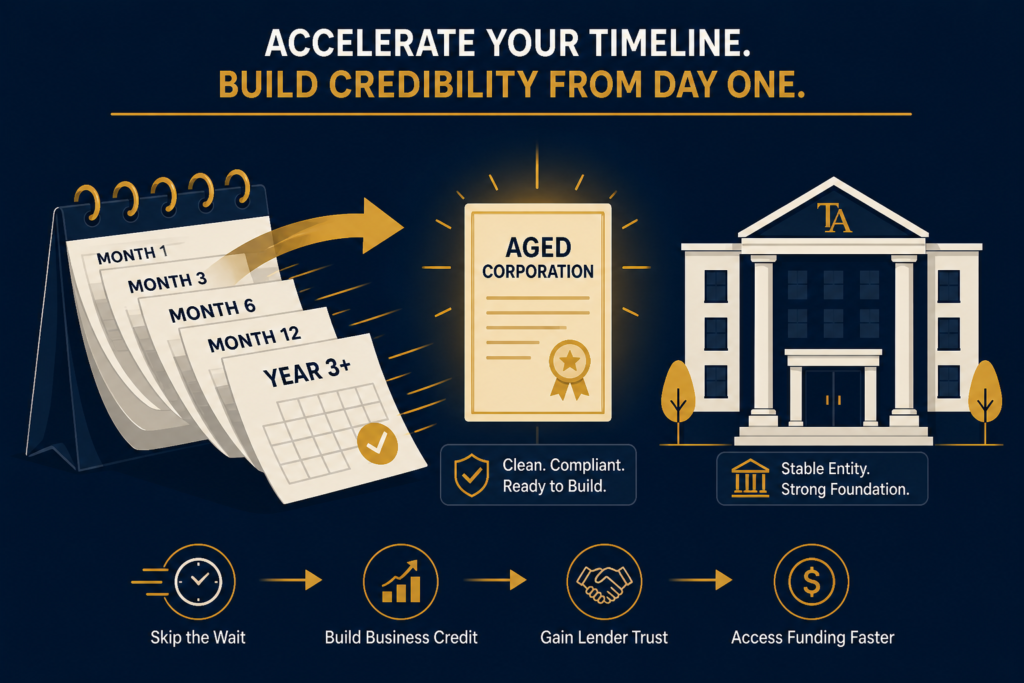
A shelf corporation, also called an aged shelf company or aged corporation, is a business entity that was legally formed in the past, has remained in continuous good standing with the state, and has never conducted any business activity. No transactions. No debt. No prior owners other than the original incorporators.
When you transfer ownership of a clean shelf corporation, you legally inherit its formation date. That date is on file with the Secretary of State. It is publicly verifiable. And it immediately satisfies the time-in-business threshold that has been blocking your applications.
This is not a workaround or a trick. Buying and selling business entities is a standard legal practice that happens every day. What makes the shelf corporation particularly useful is that it has a history without complications, age without prior activity, and no liabilities or tax exposure.
Real Scenario: When Credentials Are Not the Problem
Teresa runs a boutique marketing consultancy. She launched it fifteen months ago, has two steady retainer clients, and a personal credit score of 705. By any reasonable standard, she is a fundable business owner. She had been rejected three times for a business line of credit. Each letter said the same thing: insufficient time in business. She transferred a three-year-old clean shelf corporation. Within four weeks, she had her DUNS number registered, a dedicated business bank account open, and her first net-30 vendor account reporting to Dun & Bradstreet. Six weeks after that, she was approved for a $25,000 business line of credit through a regional bank. Nothing about Teresa’s qualifications changed. What changed was that her application now reached the underwriting stage, and her credentials were genuinely strong once anyone looked at them.
Teresa’s situation is not rare. The credentials were always there. The shelf corporation made them visible to lenders.
How to Build Business Credibility for Funding After the Transfer
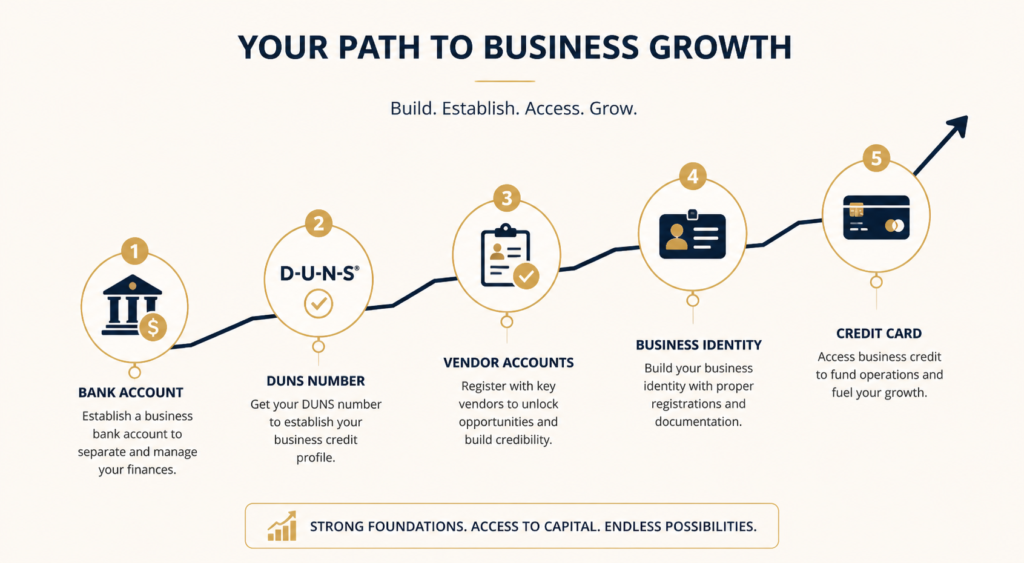
Acquiring a clean shelf corporation handles the entity age problem. But to fully build business credibility for funding, you need to actively construct the rest of your profile in the weeks following the transfer. Here is the exact sequence:
- Open a dedicated business bank account on day one. Lenders review three to six months of bank statements during underwriting. They want to see consistent deposits, healthy balances, and zero commingling of personal and business funds. The sooner you open the account and use it properly, the stronger your banking history will be when you apply.
- Register your DUNS number with Dun & Bradstreet. This is the foundation of your commercial credit profile. Your DUNS number links your entity to the major commercial credit bureaus and is required by most lenders, vendors, and government procurement systems before they will evaluate your business. Registration is free but takes one to two weeks to process.
- Apply for net-30 vendor accounts. These are trade accounts where suppliers extend thirty-day payment terms and report your payment history to commercial bureaus. This is how your Paydex score begins to build. A score of 80 or above, meaning you pay on time or early, signals reliable payment behavior and opens access to larger credit products.
- Establish a complete and consistent business identity. A professional business address, a listed phone number, a functional website, and all required state business licenses create the public-record footprint that lenders verify automatically. Gaps or inconsistencies between your application and public records trigger manual review or denial.
- Apply for a secured business credit card. Once you have two to three vendor tradelines reporting, add a revolving credit account to your profile. Most lenders want to see both installment-style trade credit and revolving credit before approving larger lines. A secured business card is the most accessible starting point and builds your profile simultaneously.
Realistic timeline: Building a fundable business credit profile takes six to twelve weeks of consistent action after the shelf corporation transfer. This is dramatically faster than waiting twelve to twenty-four months for a new entity to age, but it is not instant. The shelf corporation solves the entity age problem. You still build everything else on top.
Clean vs. Dirty: The Shelf Corporation Distinction That Determines Everything
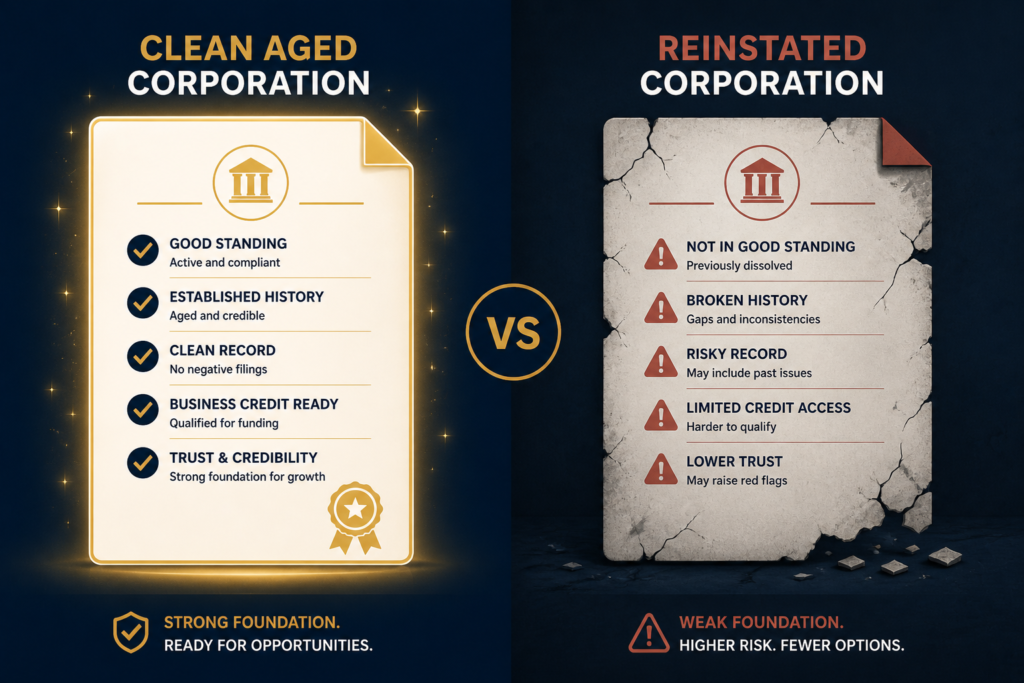
Not every shelf corporation builds credibility; some destroy it. The quality of the entity you acquire is the single most important variable in this strategy. A clean, continuously maintained entity is a genuine asset. A dissolved-and-reinstated one can trigger automatic rejections and fraud reviews.
| Clean Aged Shelf Company | Dirty or Reinstated Company |
| Zero prior business activity | May have hidden liabilities or lawsuits |
| Certificate of Good Standing provided | Dissolved and reinstated, lenders flag immediately |
| No tax history, new EIN issued after transfer | Prior tax filings become your liability |
| State records have been continuously active since their formation | Gap in active status visible in public records |
| Full documentation: articles, agent, filings | Incomplete or missing formation documents |
| Lender verification passes smoothly | Automated systems may auto-decline the application |
The most dangerous mistake buyers make is purchasing a reinstated corporation, one that lost its legal standing due to missed filings and was later reactivated. These entities show a compliance gap in public records that reads as active → dissolved → active. Lenders’ automated underwriting systems flag this pattern immediately. The aged history becomes worthless, and the application may trigger a fraud review.
Always verify independently through the state’s Secretary of State portal before completing any transfer. A reputable provider will give you the entity’s filing reference number and actively encourage you to check it yourself. If a seller discourages verification, that is a serious red flag.
Is This a Legal Way to Build Business Credibility?
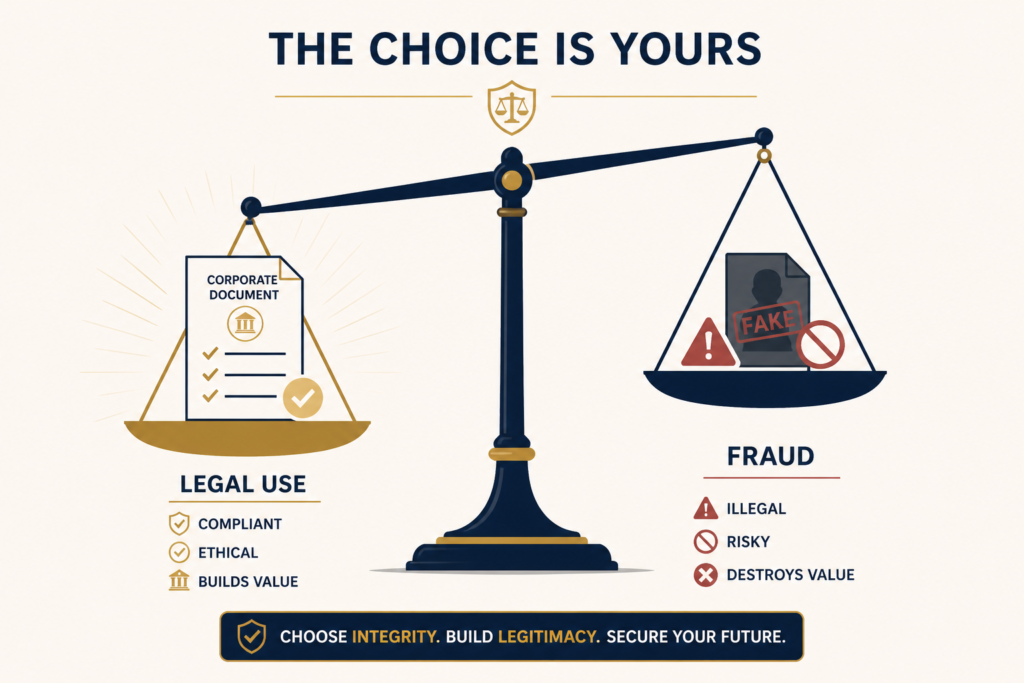
Yes, completely. Buying and selling business entities is a routine, legally recognized practice in every U.S. state. Businesses change hands through acquisitions and ownership transfers regularly. When you acquire an existing entity, you inherit its legal history, including its formation date. That is standard corporate law, not a loophole.
The legal boundary is straightforward: using a shelf corporation to satisfy a time-in-business threshold is legal and legitimate. Using one to fabricate operational history, claiming revenue, transactions, or business activity that never happened, crosses into loan fraud, which is a federal crime.
A clean shelf corporation requires no fabrication. The formation date is real and verifiable. You own the entity now. Issuance of a new EIN after the transfer ensures you have zero exposure to any prior tax period, your business starts fresh with an established formation date, and a clean financial identity.
Who Should Use This Strategy to Build Credibility for Funding
This approach works best for a specific type of business owner. It is not a universal solution, but for the right person, it removes the biggest obstacle between their qualifications and a lender’s approval.
Strong fit, this strategy makes sense if:
- Your business entity is less than two years old, and you have been denied funding specifically because of the time-in-business requirement. This is the exact problem a clean shelf corporation solves, directly and immediately.
- You have strong personal credit and genuine business qualifications, but cannot get them in front of an underwriter because the entity age filter keeps rejecting your application at the first checkpoint.
- You are launching a new venture and want to start building your business credit profile from day one rather than spending the first year waiting for your formation date to catch up with lender requirements.
- You are a real estate investor, contractor, consultant, or government contractor competing for opportunities that require a minimum business age; an established entity lets you compete immediately.
Not a strong fit, reconsider if:
- Your personal credit score is below 600, or you carry significant existing debt. The shelf corporation clears the entity age gate, but poor personal credit still blocks you at underwriting. Work on credit fundamentals first and use the shelf corporation when your full profile is ready.
- You are looking for a product that eliminates all work. The credit building, banking activity, vendor accounts, and documentation still need to happen after the transfer; the shelf corporation accelerates your timeline, but it does not remove the effort.
Frequently Asked Questions
How long does it take to build business credibility for funding?
With a new entity started from scratch, the time-in-business requirement alone means waiting twelve to twenty-four months before most lenders will consider your application. With a clean shelf corporation satisfying the age threshold, you can begin actively building your business credit profile immediately. A fundable profile, with a DUNS number, two to three vendor tradelines, a business bank account, and a business credit card, typically takes six to twelve weeks to establish after the transfer. Total time from entity acquisition to first meaningful funding application: sixty to ninety days for well-prepared applicants.
Do lenders check when ownership of a shelf corporation was transferred?
Lenders primarily verify the entity’s formation date through state public records; they are evaluating the business entity, not the personal ownership timeline. Business entities change ownership regularly through acquisitions and transfers, and lenders do not typically disqualify companies based on a recent ownership change. If asked directly about the ownership history, be transparent and honest. Misrepresentation to a financial institution is fraud, and transparency is the only approach that builds a durable lending relationship.
What is the minimum personal credit score needed alongside a shelf corporation?
Most traditional lenders look for a personal credit score of at least 650 to 680 for business credit lines and term loans, with scores above 700 improving both approval odds and interest rates. Alternative lenders may work with scores as low as 580 to 600, though at higher rates. A shelf corporation handles the entity age problem; it does not compensate for a low personal credit score. Both need to be in reasonable shape to achieve funding approval.
Can a shelf corporation help with government contract eligibility?
Yes, this is one of the most straightforward uses of a clean shelf corporation. Many federal, state, and local government contract programs require businesses to have been operational for a minimum number of years. A clean entity with a formation date that satisfies that requirement allows you to bid on contracts that would otherwise be unavailable to a newly formed business. Ensure the entity is also properly registered in SAM.gov for federal contracts and in any applicable state procurement systems.
What documents should a reputable shelf corporation provider give me?
A legitimate provider should deliver: a Certificate of Good Standing from the state of formation, the original Articles of Incorporation, confirmation of the registered agent, a full state filing history showing continuous good standing from formation to present, and a new EIN issued in your name after the transfer. The provider should also actively encourage you to independently verify the entity through the state’s Secretary of State portal. Any seller who discourages verification or cannot provide these documents is not a provider you should work with.
The Bottom Line: Credibility Is Buildable, You Just Need the Right Starting Point
The path to building business credibility for funding is not as long as most people think, but it does require solving the right problems in the right order.
Entity age is the first filter. Personal and business credit are the second. Revenue and documentation are the third. Most business owners are working on the second and third, while the first blocks everything they do.
A clean shelf corporation solves the first problem immediately. It gives your application a legitimate entity with a real, verifiable history, one that clears the age gate and puts your actual qualifications in front of a human underwriter for the first time. What happens from there depends entirely on the profile you build after the transfer.
Do that work deliberately, open the right accounts, register with the right bureaus, establish the right vendor relationships, and you can build a genuinely fundable business in the time it would have taken a new entity just to reach the starting line.
Ready to take the next step? View Available Shelf Corporations at Tradeline Associates or Learn How Business Credit Building Works to map out your plan.
Sources & Further Reading
- U.S. Small Business Administration — Five Factors That Impact Business Credit
- Federal Reserve Small Business Credit Survey — 2025 Annual Report
- Bank of America — Factors That Impact Loan Decisions
- Nav — Are Shelf Corporations Legitimate?
- Federal Reserve SBCS — Small Business Lending Survey Key Findings 2026